What happens to the skin around the eyes?
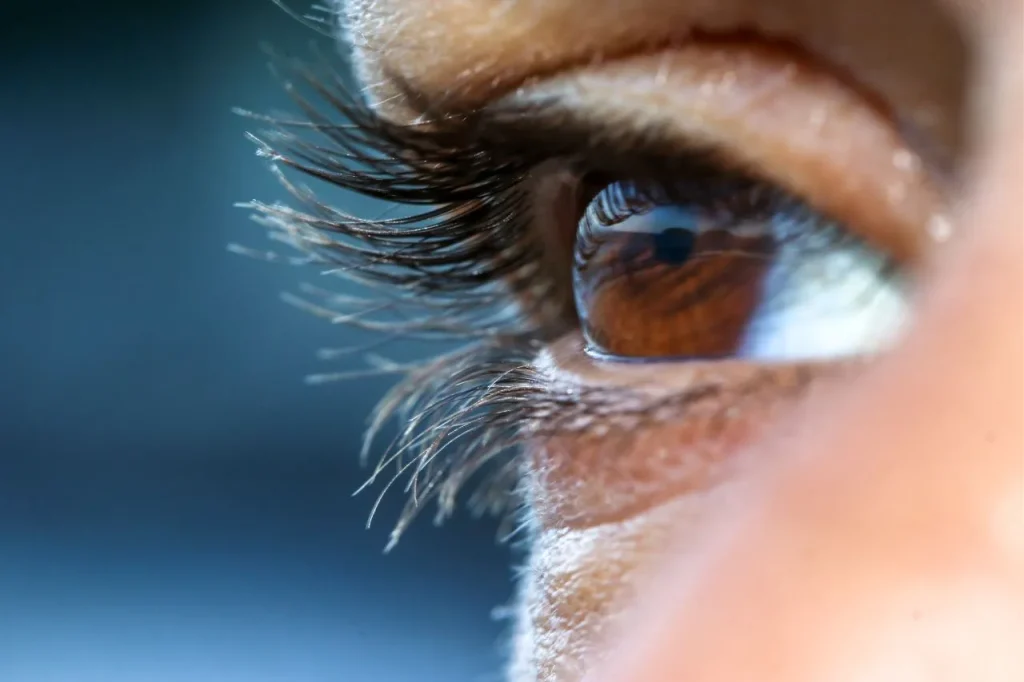
The skin around the eyes is the thinnest on the body, has very little fat beneath it and is constantly moving. Blinking, smiling, frowning and expressing surprise produce thousands of small contractions each day. Over the years, they can leave visible marks.
That mechanical strain is accompanied by a gradual loss of collagen and elastin, changes in microcirculation, redistribution of fat and weakening of supporting tissues. Understanding these processes helps explain what changes, why it changes and how it progresses.
Looking at the whole eye area
Crow’s feet: when expressions leave a mark
Lines beside the eyes form through repeated use of the orbicularis muscle. At a microscopic level, collagen fibres fragment and the dermis loses elasticity. After each contraction, the skin becomes less able to spring back and the crease starts to persist.
At first, these are dynamic lines that show when you smile. As the skin becomes less resilient, the lines can also become visible at rest.
Drooping eyelids: a gradual loss of support
Several factors can occur together: loose skin, a lower brow, muscle weakness and bulging pockets of fat.
With age, the structures holding the upper lid in place lose tension. Gravity continues to act and the eyes may look heavier. In some cases the change can also restrict the field of vision.
Dark circles can have more than one cause
In some people pigmentation predominates. In others, vessels show through very thin skin. Loss of fat can cause hollowness, while displaced fat from the eye socket can create a bulge.
Microcirculation, skin quality, bone structure and genetics all play a part. Two people of the same age can have dark circles that differ considerably in cause and progression.
Under-eye bags: when fat shifts position
Under-eye bags often form as fat surrounding the eyeball bulges forward. Over time, the septum holding it in place can weaken and allow the fat to shift.
Fluid retention or temporary factors may contribute. In many cases, a gradual structural change is also involved. Bags can be more noticeable in the morning and remain visible throughout the day.
Forehead lines and frown lines
The forehead and the area between the brows change through a mechanism similar to that behind crow’s feet. The frontalis and corrugator muscles can activate without conscious effort in response to stress, concentration or bright light.
Over time, repeated contractions can leave deep lines that convey concern or tiredness even when the face is relaxed. The skin, muscles and the nerves that control them all play a role.
How changes around the eyes are treated today
Assessment starts with identifying which structure has changed.
For expression lines, including crow’s feet, forehead lines and frown lines, neuromodulators may be considered. They are sometimes combined with laser treatment to stimulate collagen production and soften established lines.
When drooping lids or bags have a pronounced structural component, blepharoplasty may be considered to remove or redistribute skin and fat. Medical lasers offer other options for some concerns involving texture, firmness and brightness, particularly in thin skin.
For dark circles the plan depends on the cause. Hyaluronic acid filler may be considered for hollowness, laser if skin or vessels are the main concern, and combined approaches if several factors are present.
A functional structure beneath the skin
Thin muscles, fat compartments, supporting ligaments and superficial blood vessels overlap around the eyes. This allows constant movement with very little thickness. Structural changes can therefore become visible sooner than elsewhere on the face. Blood and lymphatic circulation in this region are sensitive to hormones, rest and ageing of connective tissue.
The area protects the eye, supports its movement and responds quickly to external stimuli. Its sensitivity and need to adapt to changes in function and environment help explain how it changes over time.