Inventions of 2026
Inventions of 2026: when artificial intelligence reaches healthcare, the home and everyday life
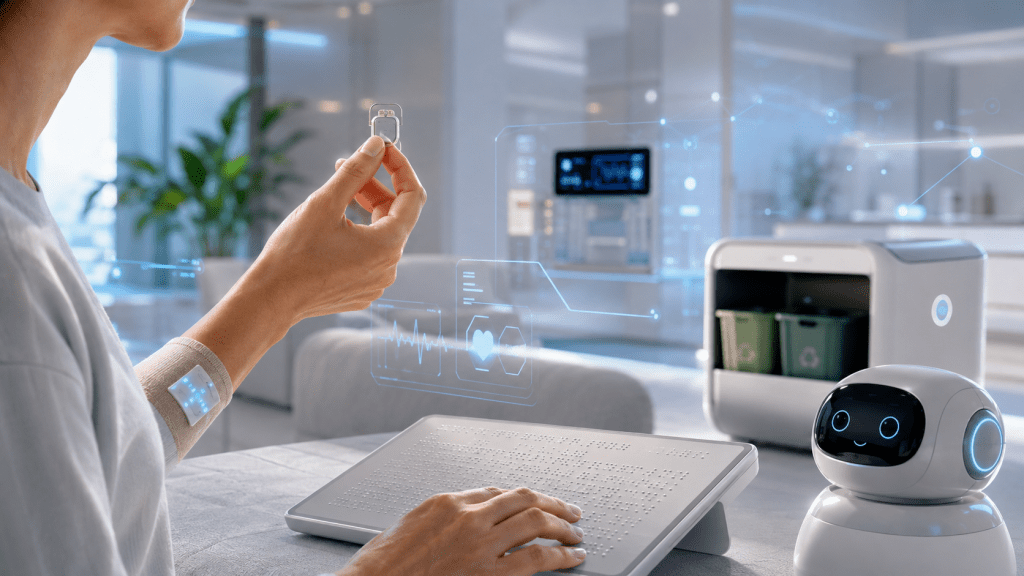
Major advances in technology sometimes seem to come straight out of science fiction. In 2025, however, many of these ideas are starting to find real applications: tiny pacemakers that dissolve in the body, tactile devices for people with visual impairments, smart dressings, companion robots and appliances that can reduce household waste.
Three broad trends are shaping the latest inventions: the integration of artificial intelligence, biotechnology and the Internet of Things. Alongside making devices faster or smaller, designers are looking for ways to improve health, help people live more independently and make daily life more sustainable.
Some of the most promising innovations
More precise, less invasive healthcare. One striking development is a temporary pacemaker smaller than a grain of rice, designed especially for newborns with congenital heart conditions. It can dissolve once it is no longer needed, avoiding a second operation to remove it.
Technology for inclusion. Devices such as Monarch represent an important step for students with visual impairments. This multiline braille tablet can display text and tactile graphics, making digital books, diagrams and complex learning materials more accessible.
Smart dressings. Solutions such as CureSilk combine spider silk proteins with an app that analyses photographs of wounds. The aim is to help assess how a wound is healing and guide how the dressing is used.
More sustainable homes. Household appliances such as PORE can dry and grind food waste, substantially reducing its weight. Inventions of this kind address concerns about recycling and reducing organic waste at home.
Questions these advances raise
Many of these inventions are still at an early stage, are expensive or depend on technological infrastructure that is not available to everyone. Artificial intelligence in healthcare also raises important questions. Who interprets the data? What is the margin of error? How is patient privacy protected?
There is also a tendency to describe every advance as revolutionary, even when it may take years to reach the market or find use only in very specific settings.
A real revolution or the promise of one?
The inventions of 2025 point to a future that feels closer, with less invasive medicine, more accessible education, smarter homes and machines able to keep people company or assist them. It is worth keeping these developments in perspective. Some will change how things are done, while others will remain ingenious prototypes that never catch on.
What matters is how well an innovation solves a real problem. That is what separates an intriguing invention from a technology capable of changing lives.
> CLÍNICAS NG NEWS section
Medical centre authorised by the Government of Catalonia, registration no. E08945122
Plastic, reconstructive and aesthetic surgery
Aesthetic medicine
93 716 95 25
654 32 67 57
// About Dr Nélida Grande
Dr Grande graduated in Medicine and Surgery from the Autonomous University of Barcelona. She specialises in plastic surgery of the breasts, body and face, and in advanced aesthetic medicine treatments. Drawing on her extensive professional experience, she sees beauty as closely linked to health. Her approach is to treat the body so that the mind can find its balance.